... you make green tomato salsa!
I will admit, I had low hopes for our tomato crops this year. The fact that any of them grew at all was a pleasant surprise. The fact that most of them thrived and gave lots of fruit was astounding.
That fruit, however, is still green on the vine and with the warmer days now fading behind us I know the chance of them ripening soon is slim.
So tonight I picked three of the ripest ones, as well as a small but pungent bunch of cilantro and one tiny jalapeño pepper. Chopped it all coarsely, added some salt, lemon juice and olive oil and voila! A very delicious and super-fresh green tomato salsa.
Nothing goes to waste around here!
Tuesday, September 20, 2011
Sunday, September 11, 2011
Help me identify these berries!
These berries came from bushes on our hillside, but we're not sure exactly what they are. Can anyone help?
Tuesday, July 26, 2011
Growing Radishes = Gratifying
Thank goodness for the radish. I was beginning to think I had black thumbs, but those tiny seeds have renewed my hope! They are so easy to grow and mercifully quick as well. If there's one thing I am learning from my gardening adventure this summer it is patience. Things are growing out there, but they are doing it at their own pace. So each time I check on the radishes and they've come up another quarter of an inch I am thrilled! I'm looking forward to grated radish salads very soon.
Wednesday, May 11, 2011
Homemade brownies from cocoa powder
I am almost ashamed to admit that, until last night, I had never made homemade brownies from scratch. I knew it could be done, but had never done anything other than mix up a batch from a box.
Never again... the brownies I made last night were fantastic, with a rich chocolate taste and a dense, cake-like consistency.
Here's my recipe:
(My version is amended from this Epicurious recipe.)
Never again... the brownies I made last night were fantastic, with a rich chocolate taste and a dense, cake-like consistency.
Here's my recipe:
- 1/2 cup unsalted butter
- 1 cup granulated sugar
- 3/4 cup plus 2 tablespoons unsweetened cocoa powder
- 1/4 teaspoon salt
- 1/2 teaspoon pure vanilla extract
- 2 cold large eggs
- 1/2 cup all-purpose flour
- 2/3 cup walnut pieces (optional)
1. Preheat oven to 325°F. Line the bottom and sides of an 8" baking pan with parchment paper.
2. Combine the butter, sugar, cocoa, and salt in a stainless steel mixing bowl and set the bowl in a wide skillet of barely simmering water. Stir until the butter melts. The mixture will come together like a dough and will look a bit grainy. When all the butter is melted, remove the bowl from the skillet and set aside briefly to let the mixture cool a bit. It should be warm, not hot.
3. Add the vanilla and stir with a wooden spoon.
4. Add the eggs one at a time, stirring to combine completely after each one.
5. When the batter looks thick, shiny, and well blended, add the flour and stir vigorously until it is completely blended in. Stir in the nuts, if using.
6. Spread evenly in the lined pan.
7. Bake for about 20-25 minutes, until the blade of a paring knife comes out slightly moist with batter.
8. Cool completely before cutting.
Lift up the ends of the parchment or foil liner, and transfer the brownies to a cutting board. Cut into 16 or 25 squares.
(My version is amended from this Epicurious recipe.)
Tuesday, April 12, 2011
Black Radish and Walnut Slaw
| photo courtesy www.uniprix.com |
I had never seen nor cooked with these before, so I did a little research and found out that they are a winter favourite in places like Russia and France.
Some sites suggested cooking them like a turnip, but that didn't sound terribly appealing.
Instead, I decided to make a salad. First I peeled the radishes, though I don't know if that was a necessary step. Next time I might try leaving the skin on.
Then I grated them (I used three medium-sized radishes) and finely diced one stalk of celery. I had some spare dill and mint around, so added a little of that, along with a thinly sliced shallot and some chopped walnuts. Lightly dressed with white wine vinegar, olive oil, salt and pepper -- it was delicious!
Wednesday, March 23, 2011
Judging a recipe by its cover
I have stacks - and I mean STACKS - of cookbooks. But I haven't cracked any of them open in ages. They're neatly packed away in boxes in the basement, waiting till we move to a home where I can get them up on to shelves.
In the meantime, I turn to the internet when I need a recipe. My mother had a recipe box where she filed away her favourites. I have a folder of bookmarks in my browser. There are a few sites I trust to give me decent results each time - BBC Food, Epicurious, the NY Times (though now that the paywall is up I will be using that less) - but more often than not I end up using a recipe from a blog I've never heard of.
The results can be hit or miss for sure. Many home bakers use way more sugar than I normally would, for example. But there are some amazing cooks out there and one of the best things about the internet is the way it connects us all together.
I have taken to using Google's image search in conjunction with a web search to get to the best recipes. That's not to say a recipe without a photo or with a bad photo will not give good returns, but I like the ability to see what I'm going to get before I dive in.
In the meantime, I turn to the internet when I need a recipe. My mother had a recipe box where she filed away her favourites. I have a folder of bookmarks in my browser. There are a few sites I trust to give me decent results each time - BBC Food, Epicurious, the NY Times (though now that the paywall is up I will be using that less) - but more often than not I end up using a recipe from a blog I've never heard of.
The results can be hit or miss for sure. Many home bakers use way more sugar than I normally would, for example. But there are some amazing cooks out there and one of the best things about the internet is the way it connects us all together.
I have taken to using Google's image search in conjunction with a web search to get to the best recipes. That's not to say a recipe without a photo or with a bad photo will not give good returns, but I like the ability to see what I'm going to get before I dive in.
Monday, February 28, 2011
Quiche, from scratch, in less than an hour
I've made quiche loads of times before but before today had never attempted my own crust. But high on the success of my sfeeha (middle eastern meat pies) last week, I thought I'd give it a go and soon found out it is super easy!
I took one cup of flour and forked it together with 1/2 teaspoon of salt in a large mixing bowl. Then, using the same cup measure, I whisked together 1/4 cup olive oil with 1/4 cup cold tap water. Once it was thick, I poured it into the flour and mixed together to form a dough. Press that into a 9-inch pie pan and it's ready for the quiche filling of your choice!
I went with spinach, mushroom and cheese, and also threw in a little bit of red pepper that I had lying around. The spinach was the chopped, frozen kind so that needed to cook first. Then, I lined the crust with the chopped mushrooms and red pepper, added the cooked spinach, then poured over a batter made from 3 eggs, 1 1/2 cups milk and about 1 cup of shredded cheddar cheese, seasoned to taste.
Bake the whole thing at 400º F until the crust is golden and the center of the quiche is firm, about 30 minutes.
Wednesday, February 16, 2011
Quick and easy pickled carrots
For a jar this size (20 oz), use about 2 cups of white vinegar.
Add salt and sugar to taste and dissolve completely before pouring over the carrots. I used about 4 tablespoons of sugar and 1 1/2 tablespoons of sugar, but play around with it to get it just right for you.
Optional: add sliced chili peppers and/or julienned ginger.
Thursday, January 20, 2011
Friday, January 07, 2011
The smell of zucchini bread on a snowy day
I'm not ashamed to say I frequent the discount produce rack at the supermarket. There are often things on there that are clearly past their sell-by dates, but just as often there are perfectly usable, if ugly, fruits and vegetables.
Two days ago I bought a bag of zucchinis that were not too beautiful. I used two in a vegetable soup and two more today in a nice and easy zucchini bread. One of the best things about this recipe is that it doesn't require a cake mixer, which is good since I can't find mine!!
Here's the recipe:
EASY ZUCCHINI BREAD
3 eggs, beaten
2 cups grated zucchini
1 cup vegetable oil
2 tablespoons vanilla
3 cups flour
1 1/2 cups sugar
1 teaspoon salt
1 teaspoon baking soda
1 teaspoon baking powder
1/2 teaspoon nutmeg
1/2 teaspoon cinnamon
OPTIONAL: 1/2 cup chopped walnuts
1. Grate the zucchini and combine with the beaten eggs, vanilla and oil.
2. Sift together the dry ingredients.
3. Using a spoon or rubber spatula, combine the wet and dry ingredients. Add the walnuts, if using, and mix thoroughly. Mixture will look like a thick batter or wet bread dough.
4. Grease and flour a loaf pan (or a lined muffin tin). Pour the batter into the pan until about three-quarters full.
5. Bake at 350°F for 50-60 minutes (20-30 minutes if using a muffin pan).
Monday, August 16, 2010
Frangipane and mixed berry tart
Last weekend we picked masses of wild blackberries from our seaside property in Riverport, N.S. We also managed to scrape up the last of the season's wild blueberries and a few raspberries.
With friends coming over for a Sunday dinner, we searched for an interesting way to serve the berries and came up with this fabulous frangipane tart, which is now my favourite new recipe. I plan to make it again in the fall with pears or apples in place of the berries.
You could cut the pastry dough to form a round, but we decided to go with a rectangular tart, sort of like a 'pizza rustica.'
Frangipane is an almond cream filling that can be used in tarts, pastries and cakes. Some say the name is derived from the Italian 'frangere il pane,' meaning 'break the bread.' The pastry filling is generally thought to be of Belgian origin.
1/4 cup plus 1 tablespoon white sugar
3 tablespoons unsalted butter
1 large egg
1/2 teaspoon pure vanilla extract
1/2 cup almond flour
1 tablespoon all-purpose flour
1 cup mixed berrie
1 package of puff pastry (we used Tenderflake)
With a hand mixer, cream together the butter with 1/4 cup sugar.
- Add the egg and vanilla and beat until smooth.
- Add the almond flour and all-purpose flour and beat until the mixture forms a smooth paste.
- Transfer to a small bowl, cover and refrigerate.
- Place the berries in a mixing bowl with 1 tablespoon sugar. Lightly toss to coat berries with sguar.
- Roll out puff pastry dough on a lightly floured surface to about 1/8 inch thick.
- Place on a large baking sheet.
- Leaving about a 1/2 inch border around the edge of the pastry, prick the dough with a fork to stop it from puffing up.
- Smooth the frangipane over the pastry - leaving a ½ inch border.
- Bake in the oven for 4-5 minutes.
- Remove tarts from the oven and arrange berries on top.
- Bake until pastry is crisp and golden brown - approximately 8 minutes.
Thursday, June 24, 2010
Tips from 1940s Maritime Homemakers
The Nova Scotia Public Archives do an incredible job of preserving historical documents and making them publicly available on the web. This morning I came across a wonderful 30-page book of wartime recipes for Maritime homemakers.
Although we don't have to live on war rations these days, some of the tips and recommendations in this book are as sound today as they were in 1945.
- stretch peanut butter by adding hot water
- make your own pet food with cheap stewing beef, carrots, rice and quick-cooking oats
- turn stale bread into breadcrumbs
- save juices from canned fruit for sweetening baked goods
Here's a recipe the booklet published for homemade ginger ale. I never realized it was this simple:
1 pint molasses
1 gallon water
2 tsps. ground ginger
cider vinegar
Mix together water, molasses and ginger. Add enough cider vinegar to make an acid as desired. Let stand 24 hours. Serve very cold.
Funny that in a book about economizing during the war, there is a half-page ad for the "Very Latest in Furs" -- featuring silver fox, Eastern Canadian mink and Russian squirrel scarves.
Although we don't have to live on war rations these days, some of the tips and recommendations in this book are as sound today as they were in 1945.
- stretch peanut butter by adding hot water
- make your own pet food with cheap stewing beef, carrots, rice and quick-cooking oats
- turn stale bread into breadcrumbs
- save juices from canned fruit for sweetening baked goods
Here's a recipe the booklet published for homemade ginger ale. I never realized it was this simple:
1 pint molasses
1 gallon water
2 tsps. ground ginger
cider vinegar
Mix together water, molasses and ginger. Add enough cider vinegar to make an acid as desired. Let stand 24 hours. Serve very cold.
Funny that in a book about economizing during the war, there is a half-page ad for the "Very Latest in Furs" -- featuring silver fox, Eastern Canadian mink and Russian squirrel scarves.
Wednesday, March 31, 2010
Barbecue Tonight Lives Up to Its Promise
Mention Karachi to anyone who has been or lived there and you can pretty much guarantee they will bring up these two words: Barbecue Tonight.
It is probably Karachi’s most famous restaurant, though not its fanciest by far. What started out as a roadside stand has now become a multi-story restaurant empire. Often that kind of expansion marks the beginning of the end in terms of quality, but Barbecue Tonight has managed to maintain its standards, and therefore its popularity. It’s nearly impossible to get a table on a weekend night.
The last time I was in Karachi my attempts to eat at BT were roundly foiled. Most of my meals were spoken for with invitations to the homes of friends and family. On the one free night we had, my cousin Eddie invited us out. We begged him to take us to BT, but instead he insisted on taking us to a place for Nihari, a spicy and stomach-churning Pakistani dish that he thought might gross us out. It didn’t.
I’m back in Karachi now and a plan earlier in the week to try BT was again grounded due to a nasty stomach bug that kept me home for two days eating plain rice and yogurt.
Tonight was my last night in K-town and with my stomach coated in acidophilus bacteria off we went. I must say, the place did not disappoint. The chicken tikka was nicely spiced but not burning hot, and perfectly moist. The Afghani naan, fresh from the oven, was perfectly soft and lightly sprinkled with sesame seeds. Thinly sliced mutton chops were surprisingly tasty as were the spicy mutton kebabs. And the service, complete with white-gloved waiters, was excellent.
I'm looking forward to Barbecue Tomorrow!
Thursday, January 21, 2010
Sunday, December 20, 2009
The Myth of 'Healthy' Foods
In more interesting news out of Britain, a recent survey showed that nine out of ten mothers were misled by labelling on food packaging.
The BBC reports that the survey, conducted by the British Heart Foundation, found that "mothers believe claims such as 'a source of calcium, iron and six vitamins' mean a product is likely to be healthy." The truth, the foundation revealed, is that an average serving of a product that claims to be made with whole grains and "keep your heart healthy and maintain a healthy body," such as Nestle's Honey Shreddies, actually contain more sugar than a donut.
As part of its Food4Thought campaign, the BHF examines how food manufacturers manipulate parents through distracting health-like claims to market breakfast foods and lunchbox snacks.
The report is a call to action, indicating the need for stronger regulation of junk food marketing. The BHF is asking for:
The BBC reports that the survey, conducted by the British Heart Foundation, found that "mothers believe claims such as 'a source of calcium, iron and six vitamins' mean a product is likely to be healthy." The truth, the foundation revealed, is that an average serving of a product that claims to be made with whole grains and "keep your heart healthy and maintain a healthy body," such as Nestle's Honey Shreddies, actually contain more sugar than a donut.
As part of its Food4Thought campaign, the BHF examines how food manufacturers manipulate parents through distracting health-like claims to market breakfast foods and lunchbox snacks.
The report is a call to action, indicating the need for stronger regulation of junk food marketing. The BHF is asking for:
- A ban on all junk food advertising on television before 9 p.m., allowing parents to be confident that any products they see advertised before that time are suitable for a child’s healthy diet.
- Legislation in the UK to make the regulatory framework consistent. "There must be equally stringent measures across broadcast and non-broadcast marketing and an end to the loophole that allows the claims that are outlawed in television campaigns to still be made on product packaging."
- A mandatory front of pack food labelling system to help parents understand the nutritional values of the products they are purchasing.
Thursday, November 19, 2009
Death By Popcorn
If you're like me, a big part of the fun of going to the movies is having a bucket of popcorn. I'm under no illusions that it's not the healthiest of treats, but I didn't realize just how bad it was till now.
The Center for Science in the Public Interest, a consumer advocacy group, just released a review of movie theater treats showing that a medium popcorn and medium soft drink has 1,200 calories, 60 grams of saturated fat and 980 milligrams of sodium. That, says the Chicago Tribune, is the nutritional equivalent of three Quarter Pounder hamburgers topped with 12 pats of butter.
And yet, Americans consume 16 billion quarts of popped popcorn annually or 52 quarts per man, woman and child, according to the Popcorn Board, and 30 percent of that is eaten outside the home.
But it wasn't always the favored treat of moviegoers. A 1947 New York Times article asked "Is popcorn here to stay? That's the $64 question being bounced back and forth by the nation's motion picture operators at the moment."
Popcorn sales, the article reported, had reached astronomical proportions at the movies, with some theater owners reporting larger profits from popcorn sales than from movie tickets. But the treat was not without its opponents.
The Center for Science in the Public Interest, a consumer advocacy group, just released a review of movie theater treats showing that a medium popcorn and medium soft drink has 1,200 calories, 60 grams of saturated fat and 980 milligrams of sodium. That, says the Chicago Tribune, is the nutritional equivalent of three Quarter Pounder hamburgers topped with 12 pats of butter.
And yet, Americans consume 16 billion quarts of popped popcorn annually or 52 quarts per man, woman and child, according to the Popcorn Board, and 30 percent of that is eaten outside the home.
But it wasn't always the favored treat of moviegoers. A 1947 New York Times article asked "Is popcorn here to stay? That's the $64 question being bounced back and forth by the nation's motion picture operators at the moment."
Popcorn sales, the article reported, had reached astronomical proportions at the movies, with some theater owners reporting larger profits from popcorn sales than from movie tickets. But the treat was not without its opponents.
The popping of corn in theatres is a ticklish undertaking, since the poppers give off considerable odor and, of course, a lot of folks are sensitive to the smell of hot cottonseed oil.
Some theatre men hold popcorn will eventually drive more people out of movie houses than Hollywood's best pictures will be able to drag in. Already there are signs of revolt. Loew's houses in St. Louis have banned popcorn in recent weeks and in Kansas and Indianapolis some theatres have instituted checking services for patrons bringing packages of corn.
Monday, November 16, 2009
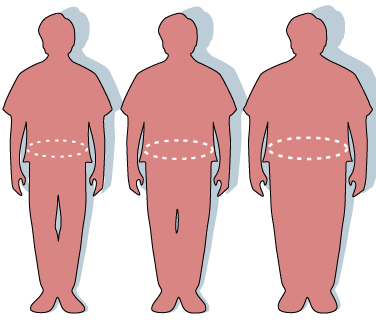
As World Leaders Tackle Hunger, What About Obesity?
As world leaders gather in Rome to discuss a new strategy to combat world hunger, a few news stories this morning highlighted the problems at the other end of the hunger spectrum: obesity and poor nutrition even in countries where food is plentiful.
America is already a world leader in obesity and Type 2 diabetes, and a story in The Times Online says that the country may be doomed to remain the leader, "as long as the process by which it elects its presidents starts in Iowa — a state known for its cornfields and corn subsidies."
If you think these sound like fattening meals, another story in the U.K.'s Daily Express describes the most common meals eaten by British families. There are, apparently, nine main dishes that most Mums rely on, including: spaghetti bolognese, roast dinners, shepherd’s or cottage pie and another pasta dish.
Translation: pasta with meat, meat with potatoes on the side, meat with potatoes on top, and another kind of pasta.
America is already a world leader in obesity and Type 2 diabetes, and a story in The Times Online says that the country may be doomed to remain the leader, "as long as the process by which it elects its presidents starts in Iowa — a state known for its cornfields and corn subsidies."
With a minimum price of $1.90 per bushel of corn guaranteed by the 2007 Farm Bill, activists say that the crop is a guaranteed winner for the farmers of the Midwest — and one of the results is something called super-abundant high-fructose corn syrup (HFCS).Americans are not alone in their weight gain, however. In Venezuela, the country's president, Hugo Chávez, "has sounded the alarm about his compatriots' expanding waistlines and called on them to wage battle against the bulge, saying the revolution needed them fit and strong," according to a story in the Guardian.
Known to its detractors as “liquid Satan”, HFCS is the sweetener of choice in the vast bulk of fizzy drinks and packaged cakes and biscuits consumed in the US. Its producers have long enjoyed the solid support of the US Senate and most presidential candidates, who gravitate every four years to Iowa to pledge their allegiance to its voters. “Farm subsidies are a third rail of Iowa politics,” a former staffer on Senator John Edwards’s presidential campaign said yesterday. “You don’t touch them.”
The 2007 Farm Bill conferred more than $2 billion on Iowa in corn subsidies for 2007 to 2012 — nearly 80 per cent of the state’s subsidies for all crops for the period. Americans’ consumption of corn on the cob has not risen markedly as a result, but their intake of HFCS has been climbing for decades, from 0.6lb per person per year in 1970 to 73.5lb in 2007.
Chávez's intervention was prompted by a study which suggested that in the past two decades the average adult Venezuelan's "excess" weight had ballooned from 6.3kg (1 stone) to 14.5kg.Battling obesity, the story explains, may be a doomed fight in Venezuela, where people are "fanatical about fattening dishes such as chicharrón (fried pork rinds) and like to fill arepas, a type of corn patty, with roast pork, beef and blocks of cheese. Meals are not complete without fizzy drinks, beer or rum and Coke."
The same study said nutrition had improved, and the president said the revolution had ensured even the poor had three meals a day. "Now we are eating better but we need to be careful," he said. "Watch out for the fat people!"
If you think these sound like fattening meals, another story in the U.K.'s Daily Express describes the most common meals eaten by British families. There are, apparently, nine main dishes that most Mums rely on, including: spaghetti bolognese, roast dinners, shepherd’s or cottage pie and another pasta dish.
Translation: pasta with meat, meat with potatoes on the side, meat with potatoes on top, and another kind of pasta.
The survey also found that cooking dinner takes the average mother 35 minutes from start to finish, and four in 10 play safe by choosing meals they know their family like.
Over a third don’t want to waste money cooking food the kids screw their noses up at, and 44 per cent don’t have the time to experiment anyway. However, two-thirds feel guilty that they don’t make the time.
Tuesday, November 10, 2009
Easy Ways to Reduce Food Waste

"Willful waste makes woeful want," as the old saying goes. Use your resources wisely and you'll save yourself from wanting -- and needing -- more than you can provide.
A new report in Britain quantifies the amount of food and drink wasted by consumers in the United Kingdom. It is estimated that 8.3 million tons of food and drink waste is generated by British households every year -- much (approximately two-thirds) of it avoidable. Often, the study found, people either cooked, prepared and served too much or didn't use the food in time.
To put this waste in perspective, the report put monetary values on the wasted food:
"To purchase the avoidable fraction of the food and drink waste would cost people in the UK a total of £12 billion per year, an average of £480 per household per year."This is roughly equivalent to every American household buying and then throwing away $800 worth of food every year.
Experts say there are a few simple rules to follow to help cut down on how much food we waste.
- Plan your shopping carefully -- come up with meal plans and grocery lists and buy only what you know you will use.
- Be aware of what's in your kitchen, refrigerator and pantry and use things up before their expiry dates.
- Make sure your refrigerator is set to the right temperature and seals properly and be mindful of what food can be frozen for use later.
- Compost your organic waste, rather than sending it to the landfill.
Sunday, November 08, 2009
Remembering the true Thanksgiving
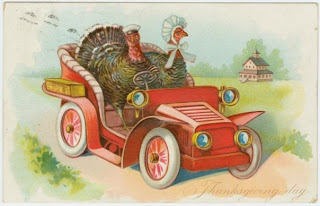
The New York Public Library has embraced social media, with a Facebook page, a Twitter feed and online galleries of their holdings. Now, to usher in Thanksgiving, they've posted a gallery of vintage Thanksgiving menus, holiday postcards and seasonal posters from their colorful visual collections.

The images are a quaint reminder of what the holiday once was -- the culmination of an "extremely auspicious season which the farmer has enjoyed in the planting, growing, and harvesting of the grain crop of the present year," as noted in The New York Times in 1851.

These days it seems we have nearly forgotten the origins of the holiday, lost as it is in a sea of football games, Macy's parades and free supermarket turkeys. For an interesting look at the origins of the observance, try this article, also from The New York Times.
The images are a quaint reminder of what the holiday once was -- the culmination of an "extremely auspicious season which the farmer has enjoyed in the planting, growing, and harvesting of the grain crop of the present year," as noted in The New York Times in 1851.
These days it seems we have nearly forgotten the origins of the holiday, lost as it is in a sea of football games, Macy's parades and free supermarket turkeys. For an interesting look at the origins of the observance, try this article, also from The New York Times.
Subscribe to:
Posts (Atom)