Monday, June 16, 2008

What is Canadian Cuisine?

Fifty years ago Harland Sanders, Kentucky's king of fried chicken, visited Canada. When asked by a reporter if he had discovered anything distinctive or characteristic about Canadian food, he had this to say:

"Well, I would say no. Not any outstanding characteristic ... I found here a lot of good and a lot of bad. Perhaps a little more bad than you do good."

I suspect that even now, 50 years later, the words 'canadian cuisine' aren't bandied about often at culinary events. It's not fare that makes headlines around the world.

I was catching up on some podcasts this weekend and heard an interview from the CBC with Gordon Ramsay. The host, Jian Ghomeshi, asked the chef how Canada can become a presence on the international stage and Ramsay had an interesting perspective. He said that Britain had been asking itself the same question for years

"The kind of crap I had to go through in Paris with the arrogance of the French and Roast Beef and Fish and Chips and Steak and Kidney pudding and 'O-la-la, your food is terrible.' So you're going through exactly what we went through. I think you are evolving, there's no two ways about that, but your exit is going to be in 10 or 15 years time when you can really implement a proper Canadian cuisine rather than a fragmented cuisine."

With all the fish, game and unique produce that we have in Canada, there really is no reason why we can't be forging a name for ourselves on the global culinary scene. Part of the challenge is overcoming our vast regional disparities and widening out our specialized ethnic cuisines to put a uniquely Canadian mark on them.

The CBC has produced a very interesting interactive map of Canadian regional foods which is a handy starting point for a discussion of what makes Canada's food distinctive. From French-inspired Pâté à la viande in the east to caribou stew in the northwest, not to mention poutine and butter tarts, we're off to a pretty good start!

Why You Should Care About Honeybees


Because bees pollinate about one-third of crop species in the U.S.

Because without this pollination we'd be left with only plants that can be wind-pollinated - things like wheat. Imagine a diet of only bread and meat. Fun for a week, maybe.

Because the loss of more than a quarter of the country's 2.4 million bee colonies - tens of billions of bees - due to Colony Collapse Disorder is projected have an $8-$12 billion effect on America's agricultural economy.

Because without the bees to pollinate our plants, we would be left with little choice except to pollinate them ourselves - BY HAND.

There was a documentary on PBS last night that described hand-pollination, which is currently taking place in a part of southern Sichuan province in China where the bee population was killed off because of overuse of pesticides. They now have to painstakingly remove the pollen off each flower, allow it to dry for two days and then crush it to a powder. Then, using a brush made of chicken feathers to replicate the bushy body of a bee, a farmer lightly dusts each blossom of a tree. One person can do about 30 trees in a day. A bee can do about 3 million blossoms.

Ten things to do to help honeybees (guardian.co.uk, May 2008)
Silence of the Bees (PBS, June 2008)

Monday, June 02, 2008

Eating the Big Easy

A few of the things I ate during the past week in New Orleans:

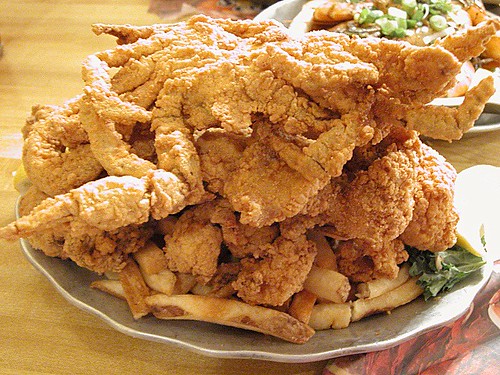
A fried seafood platter from Deanie's, a touristy restaurant in the French Quarter. It was a heaping mound of fried stuff - you couldn't tell what was what by looking, or even by tasting it. It was all fried in the same oil so it came out tasting the same. Not recommended.


Barbecued shrimp from Emeril's place in the Warehouse District. In New Orleans, this dish consists of shrimp cooked stovetop with cajun spices and lots of pepper and then coated with a spicy brown sauce. No barbecue enters the picture. These were served with a small rosemary biscuit, which to me was tastier than the shrimp.


Crawfish cheesecake, an intriguing and delicious appetizer at an Uptown restaurant called Dick & Jenny's, which serves upscale versions of creole classics. We were worried at first by the menu, which seemed a bit too ambitious, but we were not disappointed by what we were served, including a yummy gumbo and a fantastic lemon meringue pie.


Red beans and rice, at the Dillard University dining hall. This was NOT what they served me when I was in school! Considering the location, it was not half bad! And the server was a gem... a real Southern charmer who announced "Order in the window" as she passed your styrofoam plate to you across the heat lamps.


Ribs, brisket and a pulled pork sandwich at The Joint in the Bywater. This little place was amazing. You could smell the smoke for blocks. Inside there was nothing but an old Wurlitzer and some picnic tables, which was essentially all you needed. The barbecue was awesome and was served with optional vinegar-based or tomato-based sauce.


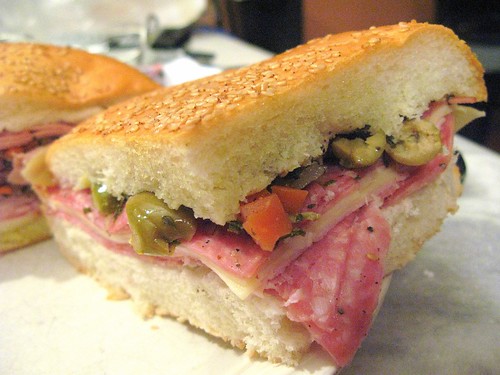
A muffaletta sandwich from Central Grocery on Decatur Street. Salty and yummy and stuffed with huge cerignolas. You have to have one of these when you're in New Orleans. I bet a better, less hyped version, exists but you still have to have one from here.


Eggs and grits with black ham from Mother's Restaurant on the corner of Poydras and Tchoupitoulas. This place is packed on weekend mornings and is famous for its baked ham. The restaurant has created its own vocabulary - Black Ham = the crisp, caramelized crust from the baked ham. Debris = the roast beef that falls into the gravy while baking in the oven.

Monday, May 12, 2008

Why Mr. Kimchi is so Popular...

Mmm... cabbage... red peppers... delicious salted fish. Aged to perfection at just the right temperature... It's Korean Kimchi!


Ahhh... Mr. Kimchi is so popular.

Thursday, May 08, 2008

Ask the Cheesehead: What makes a cheese vegetarian?

An essential ingredient in the cheese making process is rennet, which is a substance used to coagulate the milk. Rennet contains enzymes that work to separate milk into solids and liquid. Many rennets were traditionally derived from animals, specifically from the stomach of a slaughtered, unweaned calf or kid.

Cheeses that are made without the use of animal rennet are considered 'vegetarian.' This can mean that the cheese is made with a rennet that is synthetically developed or that comes from vegetable sources, such as thistles or wild artichokes. The technique of using thistles in cheese production is common in Portugal and Spain and can be seen in cheeses like Serra da Estrella or Azeitao. Microbial enzymes are used in cheeses such as Lord of the Hundreds or Westfield Capri.

Tuesday, April 29, 2008

The origins of Ketchup

The following historical recipe is courtesy of the Culinary Historians of New York

Ketchup
By Andrew F. Smith

Many people think of ketchup as a bright-red, tomato-based condiment that was invented by Americans. The word itself derives from kê-tsiap, which meant "fish pickled in brine" in Chinese dialect. The first located ketchup recipe was published in England, and it is for mushroom ketchup. Although many 18th and 19th century recipes were for mushroom ketchups, other varieties, including walnut and ketchups made from a wide range of fruits,such as apples, blackberries, peaches and tomatoes, were also popular. Early ketchups were used for flavoring savory pies, meats and other sauces.

To make Mushroom Ketchup

Take the Gills of large Mushrooms, such as are spread quite open, put them into a Skellet of Bell_Metal, or a Vessel of Earthen-Ware glazed, and set them over a gentle Fire till they begin to change into Water; and then frequently stirring them till there is as much Liquor come out of them as can be expected, pressing them often with a Spoon against the side of the Vessel; then strain off the Liquor, and put to every Quart of it about eighty Cloves, if they are fresh and good, or half as many more, if they are dry, or have been kept a long time, and about a Drachm of Mace: add to this about a Pint of strong red Port Wine that has not been adulterated, and boil them all together till you judge that every Quart has lost about a fourth Part or half a Pint; then pass it thro' a Sieve, and let it stand to cool, and when it is quite cold, bottle it up in dry Bottles of Pints or Half-Pints, and cork them close, for it is the surest way to keep these kind of Liquors in such small quantities as may be used quickly, when they come to be exposed to the Air, for fear of growing mouldy: but I have had a Bottle of this sort of Ketchup, that has been open'd and set by for above a Year, that has not received the least Damage; and some Acquaintance of mine have made of the same sort, and have kept it in Quart-Bottles to use as occasion required, and have kept it good much longer than I have done. A little of it is very rich in any Sauce, and especially when Gravey [sic] is wanting: Therefore it may be of service to Travellers, who too frequently meet with good Fish, and other Meats, in Britain, as well as in several other parts of Europe, that are spoiled in the dressing; but it must be consider'd, that there is no Salt in this, so that whenever it is used, Salt, Anchovies, or other such like relishing things, may be used with it, if they are agreeable to the Palate...

Source: Richard Bradley, The Country Gentleman's and Farmer's Monthly Director. Fifth edition. London: Woodman and Lyon, 1728. 1:142-43.